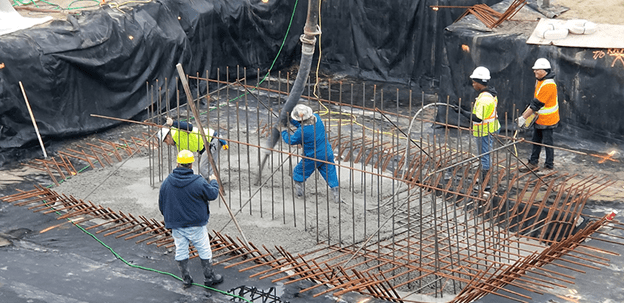
It comes down to what happens before the concrete truck ever arrives. Soil preparation, structural planning, reinforcement placement, moisture control during curing, those quiet, technical decisions are what separate a foundation that holds steady from one that slowly betrays the building above it.
At SMD Concrete Forming, we’ve seen both outcomes. We’ve walked onto sites where corners were cut, poor compaction, rushed forminand g, reinforcement thrown in without care. And we’ve built foundations that still look right years later because the early steps were handled properly. That’s the difference experienced concrete forming companies bring to a project: discipline in the details.
Concrete doesn’t fail on its own. The ground moves first. Expansive clay, poorly compacted fill, improper drainage; these conditions put stress on a foundation long before cracks appear. That’s why soil evaluation isn’t a formality. It shapes the entire approach. We look at compaction levels, moisture behavior, grading slope, and how water will move across the site during heavy rain. Reputable concrete forming companies don’t rush this phase. If the base isn’t stable, nothing above it will be either. We’d rather spend extra time compacting properly than spend years watching a slab shift.
Formwork defines everything: alignment, elevation, thickness, sand structural geometry. When forms are off by even a fraction, it compounds through the build. Doors don’t hang right. Framing needs adjustment. Stress is distributed unevenly. Good concrete forming companies treat formwork like carpentry with consequences. At SMD Concrete Forming, we measure, re-measure, and brace carefully before a drop of concrete is placed. It’s not glamorous work. But it’s the part that decides whether a foundation looks clean and square decades later.
Concrete handles compression well. Tension is another story. That’s where reinforcement earns its keep. Rebar placement isn’t guesswork. Spacing, overlap, and depth within the slab; each factor influences load transfer and crack control. When reinforcement is rushed or misaligned, the structure pays for it slowly over time. Experienced concrete forming companies understand that reinforcement is structural insurance. We follow engineered specifications closely because foundations don’t get second chances once they’re buried.
The pour itself demands attention, weather conditions, mix consistency, vibration technique, and placement sequence. Too much water in the mix weakens strength. Poor consolidation traps air. Temperature swings affect curing rates. And curing, that’s where patience matters. Concrete gains strength gradually. If it dries too quickly or isn’t protected, micro-cracks form early. We monitor curing carefully because strength development isn’t something you can eyeball. Many concrete forming companies focus on getting the job poured. We focus on getting it cured properly.
Foundations endure freeze-thaw cycles, groundwater pressure, and seasonal soil expansion. Over decades, those forces add up. That’s why drainage systems, proper footings, and expansion control are built into our approach, not added as an afterthought. At SMD Concrete Forming, we build foundations for homes, retaining walls, and structural elements that have to perform quietly year after year. No drama. No shifting. Just steady support.
We’ve seen what happens when corners are cut. Homeowners eventually call foundation repair contractors to correct settlement, cracks, or structural imbalance that could have been prevented at the start. Repairs are expensive. Disruption is worse. The smarter move is building it correctly from day one. If you’re planning a residential or commercial project, talk with SMD Concrete Forming. We bring the experience, precision, and discipline that define dependable concrete forming companies. Let’s build a foundation that holds its ground for decades, not just long enough to pass inspection.
With proper soil preparation, reinforcement, and curing, a concrete foundation can easily last 50 years or more, often much longer with proper drainage and maintenance.
Poor soil compaction, inadequate drainage, improper reinforcement placement, and rushed curing are among the most common causes.
For structural foundations, yes. Reinforcement controls cracking and improves load distribution under stress.
Absolutely. Temperature and moisture levels during pouring and curing directly influence long-term durability.
We approach foundation work with structural discipline, technical precision, and long-term performance in mind, because foundations aren’t cosmetic. They’re permanent.